Hyperbeat: Hyperliquid DeFi Banking
Hyperbeat is a Hyperliquid-native DeFi project that combines liquid banking, automated vaults, HYPE liquid staking, lending, swaps, payments, and on-chain account infrastructure into one ecosystem.

The Hyperbeat crypto project is best understood as a financial application layer for the Hyperliquid ecosystem. Its official materials describe a product suite that includes fiat-crypto conversion, high-yield accounts, a credit card experience, trading, payments, and self-custodial account infrastructure. Its docs frame the project as “powered by Hyperliquid,” using smart contracts to automate Meta-Yield vaults, delta-neutral strategies, HYPE liquid staking, money markets, and on-chain payment rails.
For beginners, Hyperbeat can be described as a DeFi-native alternative to parts of a bank account: save, earn, trade, borrow, and spend from crypto-connected accounts. For crypto-native users, the more precise description is that Hyperbeat is a Hyperliquid and HyperEVM focused DeFi stack that routes assets through smart contracts, vault infrastructure, HYPE staking, Morpho-powered lending markets, DEX aggregation, and card settlement logic. This guide avoids price predictions and does not assume a native Hyperbeat token or airdrop unless officially confirmed.
- What Hyperbeat is and how the Hyperbeat project fits into Hyperliquid DeFi.
- How Liquid Banking, Hyperbeat Pay, Earn vaults, beHYPE, dnTokens, Morphobeat, and MasterSwap work.
- Supported chains, ecosystem integrations, public metrics, audits, and funding information.
- What is known, what is unclear, and which claims should be manually verified before publishing.
- Responsible-use notes for smart contract, liquidity, leverage, oracle, bridge, and regulatory risk.
What Is Hyperbeat?
Hyperbeat is a DeFi and liquid banking project built around Hyperbeat and the Hyperbeat app. The project’s official docs say Hyperbeat uses smart contracts to automate strategies across Meta-Yield vaults, delta-neutral strategies, HYPE liquid staking, money markets, and on-chain payment rails. That places Hyperbeat in several categories at once: DeFi infrastructure, yield aggregation, liquid staking, money markets, payments, and wallet/account infrastructure.
The main value proposition is simple: let users keep ownership of on-chain assets while using financial products that resemble saving, trading, borrowing, and spending. The homepage emphasizes self-custody, on-chain verifiability, fiat-crypto conversion, yield accounts, card spending, and the ability to use crypto or other supported assets as collateral rather than selling them. The docs describe Liquid Banking as a modular, permissionless, fully on-chain financial stack designed specifically for Hyperliquid.
| Fact | Current researched detail |
|---|---|
| Project name | Hyperbeat |
| Primary category | Hyperliquid-native DeFi, liquid banking, yield infrastructure, liquid staking, lending, payments, and swaps |
| Core ecosystem | Hyperliquid, HyperEVM, and HyperCore |
| Official native Hyperbeat token | No official native Hyperbeat governance token was verified during research |
| Confirmed related assets | beHYPE, dnTokens, USD+, vault receipt tokens, and Hearts points |
| Core contributor | Hyperbeat Labs, according to official docs |
| Legal operator named in terms | Zoeion Ltd Corporation |
| Public TVL metric | DefiLlama listed Hyperbeat combined TVL at approximately $42.62 million when checked on June 26, 2026 |
How Hyperbeat Works
Hyperbeat works by combining a user-facing application with smart-contract modules that interact with Hyperliquid-native liquidity, lending, staking, trading, and payment infrastructure. Instead of acting like a centralized exchange account where users deposit assets into a custodial balance, Hyperbeat’s Liquid Banking docs describe a ManagementAccount architecture. In that design, the user is the owner of the smart contract account, while the Hyperbeat operator has restricted permissions for specific settlement actions.
The Liquid Banking architecture separates owner control, operator settlement permissions, token whitelists, service registries, spending limits, cooldowns, and mode changes. This is important because card payments and blockchain settlement do not always happen at the same speed. Hyperbeat’s model uses on-chain rules such as spending limits, withdrawal delays for settlement tokens, and operator approval for certain collateral withdrawals to reduce settlement and race-condition risk.
Hyperbeat also connects to DeFi strategies. Hyperbeat Earn vaults automate asset deployment across HyperEVM strategies. beHYPE provides liquid staking exposure for HYPE. dnTokens attempt to capture funding-rate yield from delta-neutral spot and perpetual positions. Morphobeat uses Morpho-powered money markets. MasterSwap compares routes across supported HyperEVM DEX aggregators. Together, these components form the practical Hyperbeat ecosystem.
Hyperbeat Ecosystem and Core Features
Liquid Banking
Liquid Banking is Hyperbeat’s umbrella concept for on-chain accounts, payments, credit, savings, trading, and ramps. The docs describe it as a modular stack built exclusively for Hyperliquid, with smart-contract modules that compose like building blocks. Its purpose is to let users retain ownership while accessing account-like DeFi functionality.
Hyperbeat Pay
Hyperbeat Pay is described as a crypto-native card and credit product for Hyperliquid users. Official docs say users can spend USDC or USDT in real life, take credit against a portfolio, and use a virtual or physical Hyperbeat Pay card anywhere Visa is accepted. Availability, compliance requirements, fees, and eligibility may vary by jurisdiction and should be verified in the app and current terms before use.
Hyperbeat Earn Vaults
Hyperbeat Earn vaults automate DeFi strategies on HyperEVM. The docs list vaults for assets such as HYPE, UBTC, USDT, USDC, LST assets, liquidHYPE, XAUt, and specific HIP-3 related vaults. These vaults are designed to simplify access to yield opportunities, but yield is variable and capital remains at risk.
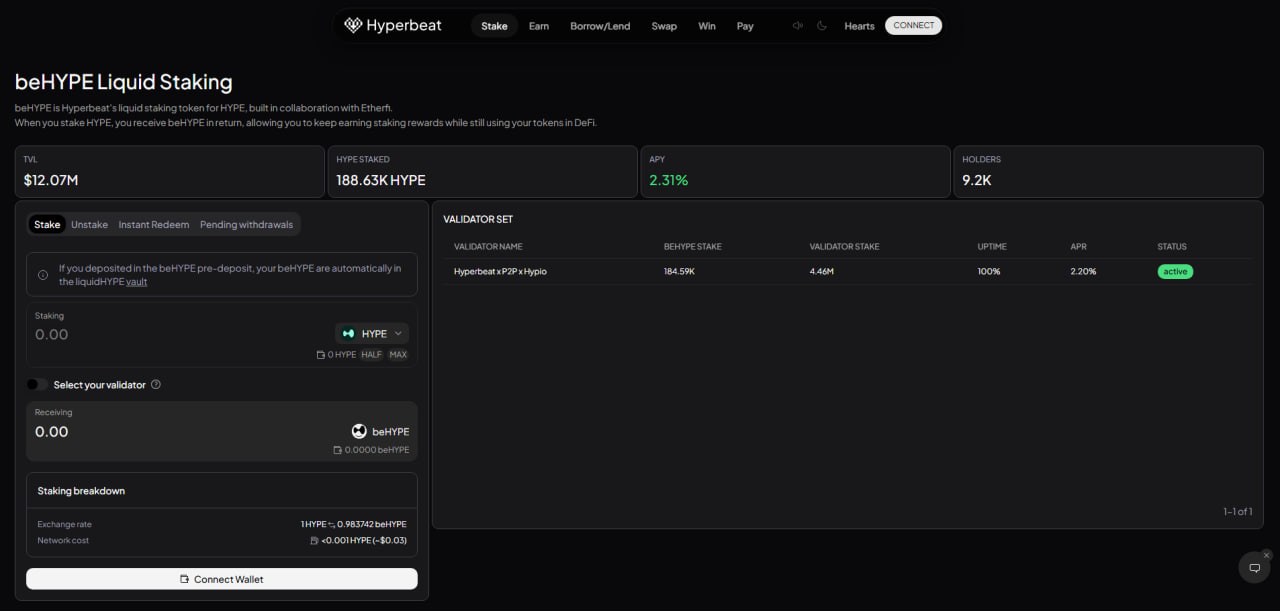
beHYPE Liquid Staking
beHYPE is the officially documented HYPE liquid staking token. When users stake HYPE through the beHYPE product, they receive beHYPE, which is designed to continue earning staking rewards while remaining usable across HyperEVM DeFi. Hyperbeat’s docs describe beHYPE as a fully on-chain HYPE liquid staking token and a composable money lego for HYPE liquid staking, validator-driven governance, and slashable HYPE security.
dnTokens
Delta-Neutral Tokens, or dnTokens, are designed to earn market-neutral yield from perpetual funding payments on Hyperliquid. The official docs describe a process where deposits are used to open matched spot and perpetual positions so net delta is near zero. This can reduce directional market exposure, but it does not remove risk. Funding can flip negative, liquidity can change, and execution costs can reduce returns.
Morphobeat and MasterSwap
Morphobeat is Hyperbeat’s Hyperliquid-native money market powered by Morpho. The docs state that markets are isolated and immutable. MasterSwap is an aggregator of DEX aggregators that compares routes across HyperEVM aggregators such as Liqd, LI.FI, OpenOcean, GlueX, Hyperbloom, KyberSwap, OogaBooga, Eisen Aggregator, and Hyperflow.
Protocol Assets, Utility, and Incentives
No official native Hyperbeat token was verified during this research. For that reason, this guide does not describe a Hyperbeat governance token, tokenomics schedule, price, or ticker. Searches for “Hyperbeat token” should be handled carefully because official docs currently highlight product-specific assets and incentives rather than a native project token.
The confirmed assets and incentive units are different from a native Hyperbeat token. beHYPE is a HYPE liquid staking token. dnTokens are ERC-20 strategy tokens for delta-neutral strategies. USD+ is a yield-generating savings vault for Liquid Banking. Vault receipt tokens represent shares in relevant vaults. Hearts is Hyperbeat’s points program, with a public docs page stating that the points formula is not public. Points should not be treated as a guaranteed token, allocation, or future airdrop.
| Name | What it is | Important caution |
|---|---|---|
| beHYPE | HYPE liquid staking token | Liquid staking can involve validator, smart contract, liquidity, and slashing-related risks. |
| dnTokens | Delta-neutral strategy tokens | Funding can turn negative and execution costs can reduce or erase yield. |
| USD+ | Yield-generating savings vault for Liquid Banking | Depends on lending-market liquidity, utilization, smart contracts, and stablecoin assumptions. |
| Vault receipt tokens | Tokens representing deposited vault shares | Receipt-token value depends on the vault strategy and underlying assets. |
| Hearts | Hyperbeat points program | Not the same as a token; no guaranteed airdrop should be assumed. |
Supported Chains, Integrations, and Partners
Hyperbeat is primarily tied to Hyperliquid, HyperEVM, and HyperCore. The homepage also advertises native multi-chain deposits, including BTC, ETH, and SOL, into Liquid Banking. That does not mean Hyperbeat is equally deployed across every chain; core protocol contracts and public metrics are heavily Hyperliquid and HyperEVM focused.
Important integrations mentioned in official or public materials include Morpho for money markets, P2P.org in relation to mainnet validator support, Ether.fi for beHYPE-related liquid staking collaboration, Turnkey for non-custodial key management in Liquid Banking, TradingView charts on the trading interface, RedStone oracle feeds for certain vault assets, and a set of HyperEVM DEX aggregators used by MasterSwap.
| Area | Supported or referenced ecosystem |
|---|---|
| Primary network stack | Hyperliquid, HyperEVM, HyperCore |
| Liquid staking | HYPE staking through beHYPE |
| Money markets | Morphobeat powered by Morpho |
| DEX aggregation | MasterSwap queries multiple HyperEVM aggregators |
| Deposits mentioned on homepage | Native BTC, ETH, and SOL deposits into Liquid Banking |
| Oracles referenced in docs | RedStone feeds for selected Hyperbeat vault assets |
Hyperbeat by the Numbers
Public metrics change quickly, so these figures should be treated as a snapshot, not permanent facts. When checked on June 26, 2026, DefiLlama listed the combined Hyperbeat page at approximately $42.62 million in total value locked, with TVL shown on Hyperliquid L1. The same page listed 30-day fees of $124,088, annualized fees of $4.57 million, cumulative revenue of $710,850, and 30-day perpetual volume of $23.1 million.
DefiLlama also listed a $5.2 million seed raise dated August 15, 2025. Public funding coverage from CoinDesk reported the round as an oversubscribed seed round co-led by ether.fi Ventures and Electric Capital, with participation from investors including Coinbase Ventures, Chapter One, Selini, Maelstrom, Anchorage Digital, and others. Metrics and raise data should be rechecked before publishing because DeFi dashboards and investor lists can update.
Security, Audits, and Risk Management
Hyperbeat publishes several security-related resources. Its audit page links to Hyperbeat audit reports and partner infrastructure audit pages for August Digital, Midas, and Morpho. Its Liquid Banking architecture page says Liquid Bank has undergone audits by Zellic and Nethermind. Public Nethermind materials describe reviews of Hyperbeat’s liquid staking, multi-asset vault infrastructure, and Liquid Bank codebase. The beHYPE docs also state that beHYPE was audited by Nethermind, Certora, and Pashov.
Hyperbeat also publishes a proof-of-solvency resource. The docs say the solvency dashboard is powered by Accountable and uses Merkle Sum Trees, secure enclaves, and zero-knowledge proofs to verify asset and liability data from on-chain and off-chain sources. This transparency feature is useful, but it should not be interpreted as a guarantee that all future smart contract, market, or operational risks are eliminated.
The Liquid Banking security model uses owner/operator separation, spending limits, whitelisted tokens, approved services, timelocks, and upgrade controls. These controls are designed to limit what an operator can do and to make card settlement safer, but users still need to understand health factors, collateral withdrawals, debt, stablecoin exposure, and account recovery.
How to Use Hyperbeat: Step-by-Step
The safest starting point is the official website and docs. Never use links from unsolicited messages, fake airdrop posts, or copied social media comments. Before depositing funds, confirm the domain, read the current terms, and start with a small amount that you can afford to risk.
- Visit the official website. Start at hyperbeat website and follow links to the app or docs from there.
- Read the product docs. Review the docs for Liquid Banking, Hyperbeat Pay, Earn vaults, beHYPE, dnTokens, Morphobeat, MasterSwap, audits, addresses, and proof of solvency.
- Check jurisdiction and eligibility. Card, credit, fiat ramp, and trading products may depend on location, identity checks, and local rules.
- Choose the product carefully. Staking HYPE for beHYPE, depositing into a vault, using MasterSwap, borrowing in Morphobeat, and using Hyperbeat Pay all involve different risk profiles.
- Verify contract addresses. Use the official addresses page and reputable explorers such as HyperEVMScan, Etherscan, or the specific explorer linked by Hyperbeat docs.
- Understand fees and withdrawals. Some strategies may have withdrawal queues, early withdrawal fees, trading costs, slippage, or settlement delays.
- Monitor positions. Vault yields, funding rates, collateral health factors, liquidity, and oracle conditions can change quickly.
Hyperbeat Compared With Similar Crypto Projects
Hyperbeat overlaps with several DeFi categories but is not identical to any single legacy project. Compared with a general yield aggregator, Hyperbeat is more tightly focused on Hyperliquid and HyperEVM. Compared with a liquid staking protocol, it offers beHYPE but also includes vaults, lending, swaps, payments, and card-related workflows. Compared with a crypto card product, Hyperbeat’s Liquid Banking design emphasizes non-custodial smart accounts and DeFi collateral rather than a purely centralized card balance.
| Category | Typical focus | How Hyperbeat differs |
|---|---|---|
| Yield aggregator | Automated DeFi yield strategies | Hyperbeat focuses on Hyperliquid and HyperEVM strategies, including Meta-Yield vaults and dnTokens. |
| Liquid staking | Stake an asset and receive a liquid receipt token | beHYPE is one product inside a broader Hyperbeat ecosystem. |
| Money market | Supply and borrow assets | Morphobeat uses Morpho-powered isolated markets within the Hyperbeat stack. |
| DEX aggregator | Find swap routes across exchanges | MasterSwap compares multiple HyperEVM aggregators rather than acting as a single DEX. |
| Crypto card | Spend crypto or stablecoins | Hyperbeat Pay is tied to Liquid Banking, smart accounts, card settlement rules, and DeFi collateral. |
Risks and Important Considerations
Hyperbeat is a sophisticated DeFi system. Its strongest features, such as self-custody, composability, leverage, liquid staking, and automated strategies, also create risk. Smart contracts can have bugs even after audits. Vault strategies can underperform. Funding rates can reverse. Lending markets can face liquidity stress. Oracles can fail or lag. Bridges and native deposit systems can introduce operational risk. Stablecoins can depeg. Regulatory access can change.
Hyperbeat’s own terms include broad digital asset risk disclosures and state that information provided through the platform should not be treated as financial, investment, tax, or legal advice. The terms also state that the company is not a financial institution, centralized exchange, trading platform, broker, or fund management platform. Users should not treat Hyperbeat as a bank deposit account with deposit insurance.
Responsible crypto disclaimer
This article is for educational purposes only and is not financial, investment, legal, or tax advice. Crypto products involve smart contract, liquidity, market, bridge, oracle, governance, operational, leverage, and regulatory risks. DeFi yields are variable and not guaranteed. Always do your own research, verify current documentation, and consider speaking with a qualified professional before using complex crypto products.
FAQ About Hyperbeat
What is Hyperbeat?
Hyperbeat is a Hyperliquid-native DeFi and liquid banking project that combines smart-contract vaults, HYPE liquid staking, money markets, swaps, payments, and on-chain account infrastructure.
Is Hyperbeat a bank?
No. Hyperbeat uses “Liquid Banking” language for its product experience, but its terms state that it is not a financial institution, broker, centralized exchange, or fund management platform. Users should review eligibility, restrictions, and local laws.
Does Hyperbeat have a native token?
No official native Hyperbeat project token was verified during research. Official docs confirm beHYPE, dnTokens, USD+, vault receipt tokens, and Hearts points, but those should not be treated as a native Hyperbeat governance token.
What is beHYPE?
beHYPE is Hyperbeat’s HYPE liquid staking token. It is designed to let users maintain HYPE staking exposure while using beHYPE in DeFi.
What chains does Hyperbeat support?
Hyperbeat is primarily built around Hyperliquid, HyperEVM, and HyperCore. The homepage also describes native BTC, ETH, and SOL deposits into Liquid Banking, but core protocol activity is Hyperliquid and HyperEVM focused.
Is Hyperbeat audited?
Hyperbeat publishes an audits page and product docs that reference audits or reviews for different parts of the system. Public materials mention firms including Nethermind, Zellic, Certora, Hacken, Sherlock, and partner infrastructure audits, depending on the product.
Is there a Hyperbeat airdrop?
No official airdrop was verified during research. Hyperbeat’s Hearts page describes a points program, but points are not the same as a token allocation or guaranteed airdrop. Be careful with fake airdrop links.
Is Hyperbeat safe to use?
No DeFi product is risk-free. Hyperbeat includes security resources, audits, proof-of-solvency materials, whitelists, and non-custodial account design, but users still face smart contract, liquidity, leverage, oracle, bridge, governance, operational, and regulatory risks.
Conclusion
Hyperbeat is one of the more ambitious DeFi projects in the Hyperliquid ecosystem because it attempts to combine liquid staking, yield vaults, money markets, swaps, trading, payments, and card-related account infrastructure in one user experience. Its core value proposition is not simply “earn yield,” but rather “use on-chain assets more like a financial account while keeping self-custody and Hyperliquid-native composability.”
The project also requires careful due diligence. Hyperbeat uses complex mechanisms such as upgradeable smart accounts, operator permissions, vault strategies, delta-neutral execution, lending collateral, card settlement, oracles, and proof systems. Before using any Hyperbeat product, readers should check the latest official docs, verify contract addresses, read relevant audit reports, understand withdrawal rules, and avoid assuming that points, yield, or future incentives are guaranteed.